

Does an Air Compressor Consume Electricity When Running Unloaded for a Long Time? How to Optimize Energy Efficiency
Article reviewed by the PhuAir Technical Department - Updated: 08/09/2026
1. Does an Air Compressor Consume Electricity When Running Unloaded for a Long Time?
Yes. An air compressor continues to consume electricity when operating in the unloaded (Unload) state for an extended period, even though the amount of useful compressed air produced is very small or negligible.
In many fixed-speed screw air compressors, the machine may switch from Load to Unload when the pressure reaches the control threshold. Depending on the design, the system reduces or stops the amount of air entering the Airend while carrying out internal venting or pressure relief according to the machine configuration.
The key point is:
Unload does not mean that the motor has stopped.
In many configurations, the motor continues rotating while the compressor waits. Therefore, if the compressor frequently remains in the Unload state for long periods, the business may incur electricity consumption without producing a corresponding amount of compressed air.
Power consumption during Unload is not the same for every compressor. It depends on the model, power rating, operating pressure, Airend design, and control method.
Should You Allow the Compressor to Run Unloaded for a Long Time?
Not if this condition occurs frequently and persists without a clear operational reason.
Rather than setting the same time limit for every compressor, assess the following:
How long does the compressor remain in Unload?
How many Load/Unload cycles occur per day?
How does the plant's air demand fluctuate?
Does the receiver provide sufficient buffer capacity?
Does the system have air leakage?
What is the current Unload Stop Timer setting?
How many starts and stops does the compressor model permit under the current operating conditions?
2. Why Does a Compressor Consume Electricity While Running Unloaded?
The process can be understood simply as follows:
LOAD → Compressor produces air → Pressure rises → UNLOAD → Motor may continue running → Electricity is consumed
When the compressor switches to Unload, it does not necessarily stop completely.
For a fixed-speed screw compressor, depending on its design, the amount of air entering the Airend may be reduced or stopped; the control system performs internal venting or pressure relief; the motor may continue rotating; and the lubrication system and rotating components continue operating as required by the design.
Therefore, power consumption continues during Unload, even though useful air output decreases significantly.
Do Not Interpret "Unload = 0% Electricity Consumption"
This is a common misconception.
Unload ≠ Stop.
The main motor stops consuming electricity only when the controller places the compressor in an appropriate stopped or Standby state, as supported by the machine's design.
Unload power consumption must be determined for the specific model or measured directly on the system, rather than calculated using a fixed percentage for all air compressors.
3. Factors That Cause a Compressor to Run Unloaded for Too Long
3.1. Actual Air Demand Is Low
If the plant consumes less air than the compressor can supply, the machine may quickly reach the set pressure and switch to Unload.
For example:
Compressor air supply exceeds actual demand
→ pressure rises quickly
→ compressor switches to Unload
→ air demand remains low
→ compressor continues waiting
→ Unload period becomes prolonged.
In this case, the problem may not lie with the compressor itself but with the mismatch between compressor capacity and the air demand profile.
3.2. The Unload Stop Timer Is Not Set Appropriately
Many air compressors have a control parameter related to how long the machine is allowed to remain in the Unload state before the motor stops or the compressor switches to Standby.
The parameter name may vary by manufacturer and controller. Examples include:
Unload Delay
Unload Stop Timer
Empty Long Stop
Auto Stop
Or an equivalent parameter.
If the waiting period is set too long, the compressor may continue running unloaded even when air demand does not increase.
Conversely, setting the time too short is not always beneficial, because the compressor may have to restart frequently when pressure drops.
Therefore:
The Unload Stop Timer must be configured based on the compressor model, the motor's start/stop limitations, and actual load characteristics.
Do not apply a fixed setting such as 5 minutes, 10 minutes, or the same time limit to every compressor.
3.3. The Air Receiver Capacity Is Unsuitable
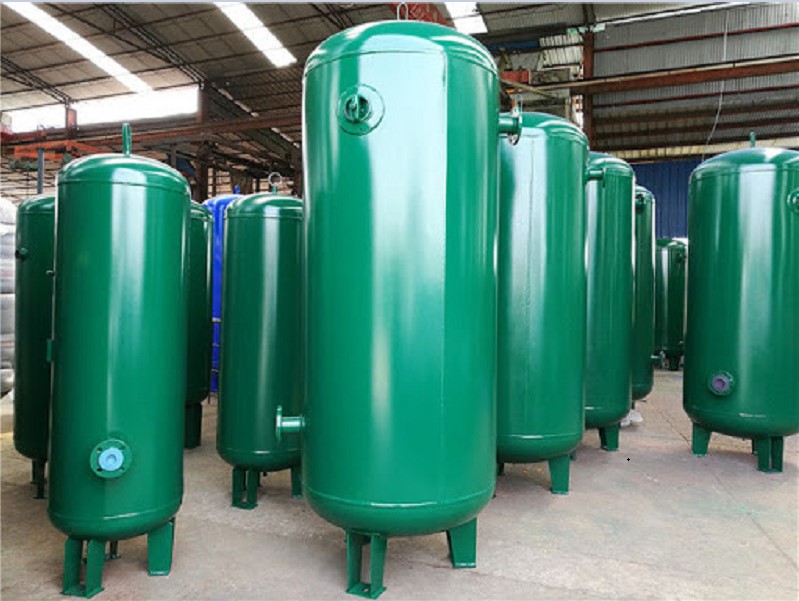
The compressed air receiver acts as a buffer between the air supply and demand.
If the buffer capacity is appropriate, the following arrangement:
Compressor → Receiver → Air-consuming system
can reduce the rate of pressure change and may extend the time between Load/Unload cycles.
However, do not assume that increasing receiver capacity will automatically save electricity.
Receiver capacity should be calculated based on compressor flow rate, air consumption profile, pressure band, number of compressors, pressure stability requirements, and control method.
For large systems, receiver capacity should be selected based on actual operating data.
3.4. Air Leakage in the System
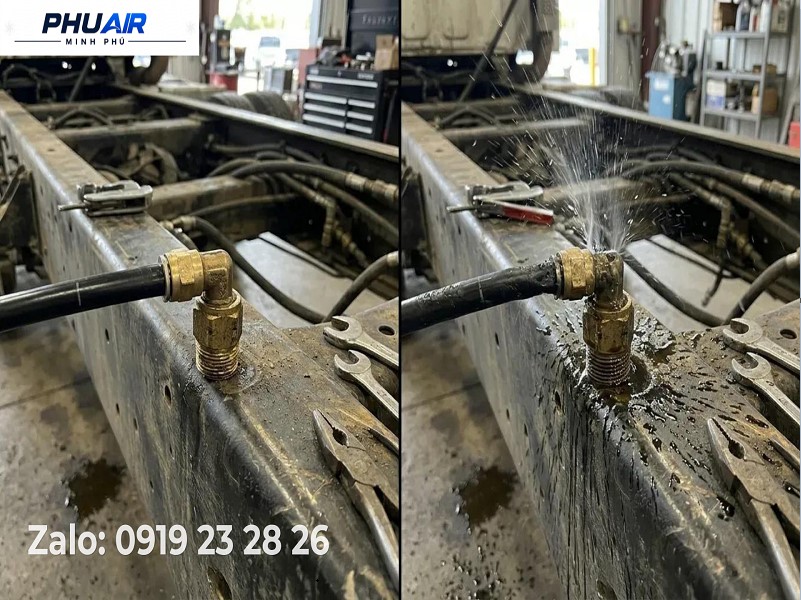
Air leakage increases the system's baseline air demand.
As a result, the compressor may cycle as follows:
LOAD → pressure reaches the setpoint → UNLOAD → pressure drops → LOAD again
If this cycle occurs frequently, inspect the piping, valves, connectors, flexible hoses, filters, air-consuming equipment, drain valves, and other potential leakage points.
Therefore, do not look at the Unload Timer alone and immediately conclude that it is the sole cause of energy waste.
4. Comparison of Energy Optimization Options
Option | Principle | When to Consider |
|---|---|---|
Optimize Load/Unload | Adjust the control logic and transition timing appropriately | Fixed-speed compressors with long Unload periods |
Optimize Unload Stop Timer | Allow the compressor to stop when air demand remains low for an extended period | Compressors that frequently run unloaded for long periods |
Increase Receiver Capacity | Provide a buffer and reduce pressure fluctuations | Systems with fluctuating air demand or short-duration peak loads |
Reduce Air Leakage | Reduce air demand that does not provide useful output | Systems with significant air leakage |
VSD | Adjust motor speed according to air demand | Systems with a load profile suitable for VSD operation |
Optimize Multiple Compressors | Distribute the load among compressors according to actual demand | Plants with multiple compressors operating in parallel |
Note
No single solution is suitable for every system.
For example, installing a VSD may provide benefits for certain load profiles, but it is not necessarily the most economical option if the system already has an appropriately configured compressor and relatively stable demand.
Businesses should evaluate the air demand profile + operating hours + energy consumption + investment cost before making a decision.
5. How to Optimize the Unload Stop Timer
Step 1: Record Operating Conditions
Monitor the following over an appropriate period:
Load duration;
Unload duration;
Number of Load/Unload cycles;
When the compressor switches to Standby;
Load/Unload pressure settings;
System air demand.
If the controller can store operating history, use this data rather than relying on observations from a single point in time.
Step 2: Determine Whether the Compressor Is Actually Running Unloaded for Too Long
Not every Unload period indicates a fault.
An Unload cycle may be normal when:
Air demand is low;
The compressor has just reached the set pressure;
The system is in a waiting state;
The Unload duration is consistent with the manufacturer's control logic.
Pay particular attention when:
The compressor frequently remains unloaded for long periods while air demand is low or nearly zero, but the motor continues running.
Step 3: Check the Control Configuration
Check the names and values of parameters related to:
Unload Delay;
Stop Timer;
Auto Stop;
Standby;
Or equivalent functions.
Do not change parameters yourself before identifying the correct model and understanding its control logic.
A suitable setting must be checked against:
The manufacturer's manual;
Start/stop limitations;
Motor power rating;
Thermal operating conditions;
Air demand profile;
Receiver capacity.
Step 4: Assess Whether the Unload Duration Can Be Reduced
If the compressor frequently remains unloaded for long periods, a technician can assess whether the stop delay should be adjusted.
The objective