

5 Principles to Prevent Recurring Pressure Drops in Air Compressors
Article reviewed by the PhuAir Technical Department – Updated: 05/09/2026
Air compressors have been repaired, but after only a period of operation, the issue of air compressor pressure drops appears again. This is a problem that causes many maintenance teams significant concern. Unstable pressure can cause CNC machines, automation equipment, and pneumatic actuators to operate incorrectly, while the compressor has to remain loaded for longer periods to compensate for insufficient air supply.
However, an air compressor pressure drop is not always caused by a compressor failure. The cause may lie in the piping, valves, filters, air treatment equipment, leakage points, or simply the fact that air demand has exceeded the system’s supply capacity.
Therefore, after correcting the initial problem, the business should inspect both the compressor and the entire compressed air network to prevent the issue from recurring after repairs.
Quick Answer
To minimize recurring pressure drops in an air compressor, five factors should be controlled simultaneously:
Piping design and sizing appropriate for the actual flow rate, with a Ring Main system prioritized where appropriate.
Control resistance across valves and filters to prevent bottlenecks from causing pressure loss.
Preventive maintenance of the Minimum Pressure Valve (MPCV) and related control mechanisms.
Establish an appropriate operating pressure and do not set the pressure higher than the actual requirement.
Conduct periodic compressed air leakage inspections, particularly at fittings, flexible hoses, and automatic drains.
Certain values such as 0.3 bar, 3.5-4.5 bar, or 1 bar may be used as reference points under certain conditions, but they should not be rigidly applied to every system. The exact values must be compared against the compressor model, flow rate, piping design, and requirements of the air-consuming equipment.
Quick Diagnostic Table for Pressure Drop Causes
Area to Check | Indication | Recommended Action |
|---|---|---|
Main piping | Pressure is sufficient in the compressor room but equipment located farther away experiences low pressure | Check pipe diameter, length, elbows/fittings, and pressure losses; consider a Ring Main if appropriate |
Piping valves | Pressure drops significantly as air flow demand increases | Check valve type, size, and open/closed condition; prioritize configurations with appropriate flow resistance |
Filters | Differential pressure across the filter increases and airflow decreases | Measure differential pressure and replace the element when the manufacturer’s limit is reached |
Minimum Pressure Valve (MPCV) | Internal compressor pressure is unstable or the valve operates abnormally | Check the piston, spring, seals, and valve opening/closing condition |
Automatic drain | Continuous air leakage noise at the drain outlet | Check the valve, clean it, or replace it if it does not close properly |
Point of use | Compressor pressure is sufficient but the end-use equipment still has insufficient pressure | Measure pressure directly at the point of use and check the filter, pressure regulator, and branch piping |
Note: The cause should not be determined solely from the pressure displayed on the compressor controller. Pressure should be compared at the compressor outlet, after the air treatment equipment, and at the point of use to identify where the pressure loss occurs.
1. Determine Correctly: Is the Compressor Losing Pressure or Is the System Losing Pressure?
This is the most important step before replacing any components.
For example, the gauge at the compressor shows 8 bar, but the CNC machine only receives 6.5-7 bar. In this case, it cannot yet be concluded that the compressor has poor pressure generation. The loss may occur in the piping, filters, valves, or air treatment equipment between the two measurement points.
Conversely, if the pressure at the compressor outlet also fails to reach the required level, the compressor itself should be inspected, including:
Inlet Valve.
Solenoid valve and Load/Unload control system.
Minimum Pressure Valve.
Air filter.
Oil separator.
Airend assembly.
Issues related to temperature and lubrication.
Principle: Measure pressure at multiple points before deciding to repair or replace components.
2. Five Golden Principles for Preventing Recurring Air Compressor Pressure Drops
Principle 1: Optimize the Piping System Using a Ring Main
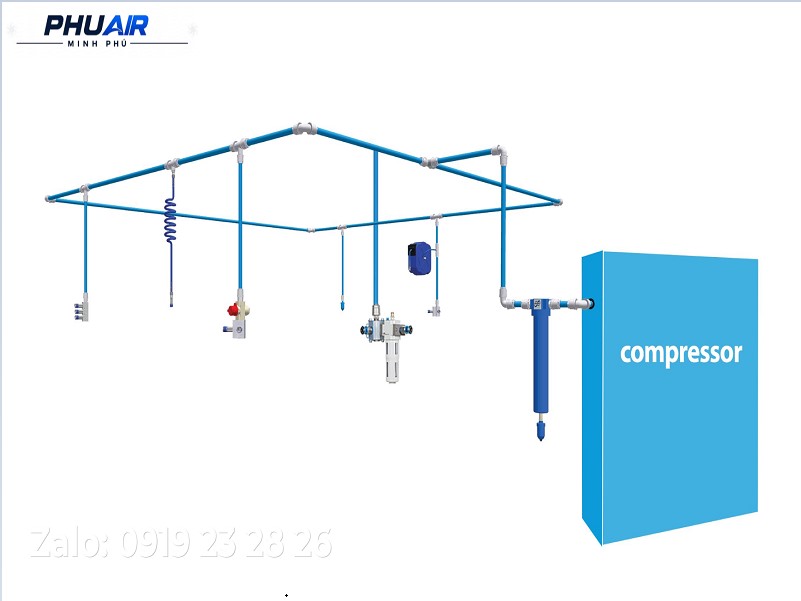
Piping is one of the factors that is often overlooked when addressing air compressor pressure drops.
If the piping is too small for the flow rate, the piping route is too long, or there are too many elbows/fittings, valves, and restrictions, pressure losses will increase as air demand increases.
Why Can a Ring Main Help Reduce Pressure Loss?
With a closed-loop piping system (Ring Main), air can reach a consumption point from multiple directions. This allows more flexible flow distribution compared with a single dead-end piping route.
In some systems, 0.3 bar may be used as a reference point for evaluating pressure loss along the piping route, but this is not a fixed limit for every factory.
Actual pressure loss also depends on:
- Air flow rate.
- Pipe diameter.
- Piping length.
- Number of elbows/fittings.
- Valve type.
- Operating pressure.
Network configuration.
Corrective action: When modifying the system, the pipe diameter and flow rate should be recalculated before changing the configuration. Do not simply increase compressor pressure to compensate for improperly designed piping.
Principle 2: Control Resistance Across Valves and Filters
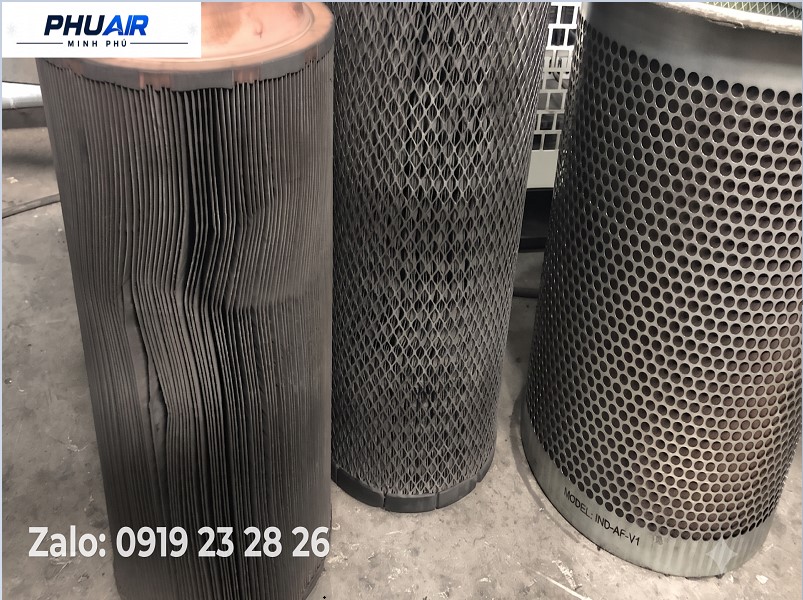
Not all of the pressure generated at the compressor reaches the end-use equipment.
Valves, filters, dryers, and piping all create a certain level of flow resistance. When these components become dirty, are incorrectly sized, or deteriorate, pressure losses can increase significantly.
For Filters
Differential pressure before and after the filter should be monitored rather than relying solely on service time.
When differential pressure increases significantly:
Airflow through the filter may decrease.
The compressor may have to operate for longer periods.
Pressure at the point of use may become unstable.
Energy costs may increase.
The replacement threshold should be based on the specifications of each filter type and the manufacturer’s recommendations rather than applying a single value to all products.
For components such as Sakura air filters, oil filters, or compressor oil separators, the correct size, filtration grade, and part number compatible with the compressor model must be selected.
Principle 3: Maintain the Minimum Pressure Valve (MPCV)
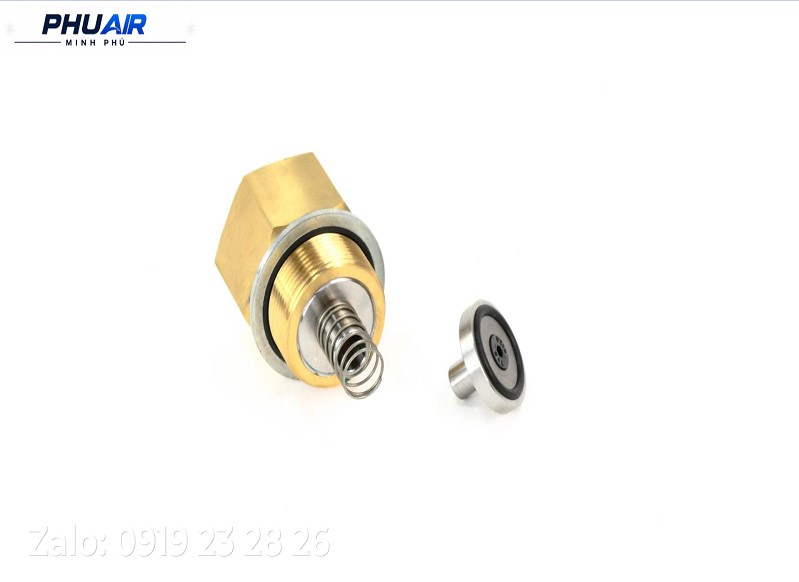
The Minimum Pressure Check Valve (MPCV) maintains minimum pressure within the oil separator vessel assembly while also controlling the airflow delivered to the system.
On some compressor models, the internal pressure that needs to be maintained may be in the range of 3.5–4.5 bar under certain operating conditions.
However, this is not a universal specification for all screw air compressors. The exact value must be checked according to the model and the manufacturer’s technical documentation.
MPCV Problems May Cause:
Unstable internal compressor pressure.
Difficulty reaching the required pressure.
Unstable compressed air supply to the system.
Leakage or abnormal operation at the valve assembly.
Preventive Measures
During appropriate maintenance intervals, technicians should inspect:
Valve spring.
Piston.
Sealing gasket.
Moving surfaces.
Oil deposits or oil residue accumulated internally.
Valve opening and closing operation.
The MPCV pressure setting should not be modified or adjusted without the technical specifications for the specific model.
Principle 4: Set an Appropriate Operating Pressure
Setting the pressure higher does not mean that the system will operate better.
If the end-use equipment only requires a certain pressure level but the compressor must continuously maintain a pressure significantly higher than the actual requirement, energy consumption may increase unnecessarily.
Under certain operating conditions, reducing the working pressure by approximately 1 bar may provide significant energy savings. Some technical documents commonly use approximately 6–10% as a reference point, but actual savings depend on:
Compressor technology.
Load/Unload mode.
Load ratio.
Air consumption.
Initial pressure setting.
Overall system configuration.
Therefore, it should not be interpreted as:
“Reducing the pressure by 1 bar will definitely save 6–10%.”
The correct approach is to measure the actual pressure at the points of use, determine the lowest pressure at which the equipment can still operate stably, and then optimize the compressor pressure setting.
Do not arbitrarily increase the pressure beyond the rated level shown on the compressor nameplate or the manufacturer’s specifications to address a pressure-drop issue.
Principle 5: Conduct Periodic Compressed Air Leakage Inspections
A system may have no compressor failure but still experience continuous pressure drops due to compressed air leakage.
Common locations that should be inspected regularly include:
Quick couplings.
Flexible hoses.
Ball valves.
Pressure regulators.
Branch piping.
Drains.
Automatic drain valves.
Threaded connections.
A drain that is stuck open can produce continuous air leakage, causing compressed air to be lost even when the production line is not consuming significant amounts of air.
Inspection Methods
For easily accessible points, an appropriate leak detection solution can be used to identify air bubbles.
For large systems, especially factories with extensive piping networks, ultrasonic leak detection equipment should be used to identify small leakage points that are difficult to detect by ear.
Inspections should preferably be carried out when:
The factory is not in production.
Air consumption is low.
Air-consuming equipment is not operating.
Once leakage points are identified, each point should be marked and repaired individually rather than simply increasing compressor pressure to compensate for the lost air.
3. 5-Step Inspection Procedure for an Air Compressor Experiencing Pressure Drops
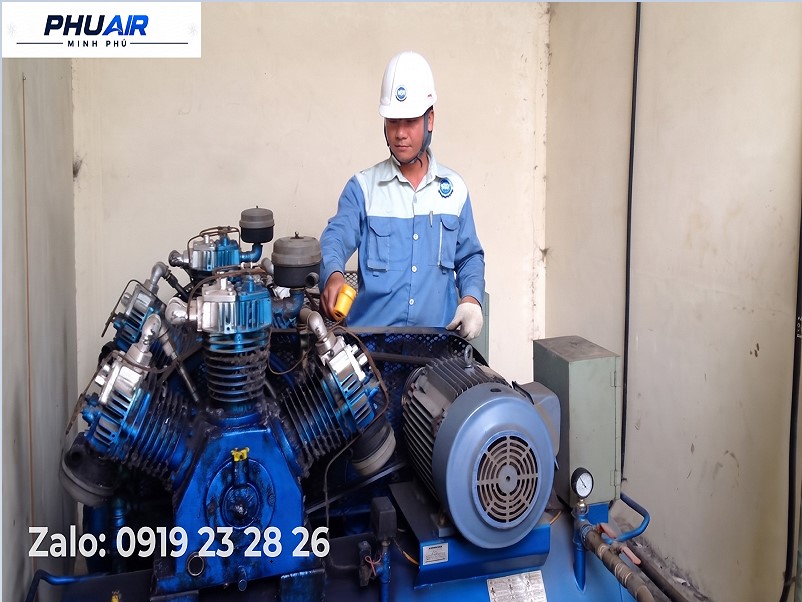
Step 1: Safely Isolate the Equipment
Press STOP, disconnect the power supply, and perform the LOTO procedure in accordance with the factory’s safety requirements.
At the same time, isolate the compressor from the compressed air network if necessary.
Step 2: Release Residual Pressure
Do not open or disassemble valve assemblies, the oil separator vessel, or piping while the system is still pressurized.
The gauge reading 0 bar is a necessary condition, but the technician must still confirm that the system has been isolated and that no other pressure sources remain before disassembly.
Pay particular attention to the risk of hot oil and compressed air remaining in enclosed chambers.
Step 3: Measure Pressure at Multiple Points
Do not check only the gauge on the compressor.
Pressure should be compared at:
Compressor → Receiver → Filter/Air Dryer → Main Piping → Point of Use
This helps accurately identify where the pressure loss begins.
Step 4: Check Potential Sources of Pressure Loss
Focus on:
Clogged filters.
Valves with high flow resistance.
Undersized piping.
Excessive elbows/fittings.
Leaking drains.
Piping leakage.
MPCV.
Compressor control valves.
If the filter or oil separator is suspected, differential pressure should be measured and compared with the manufacturer’s limit.
Step 5: Test Run and Acceptance
After corrective work is completed, start the compressor and monitor:
Pressure.
Discharge temperature.
Motor current.
Load/Unload status.
Pressure build-up time.
Pressure at the point of use.
Acceptance should not be based solely on the statement that “the compressor gauge has reached the required pressure.”
4. Common Mistakes That Cause Pressure Drops to Recur
Arbitrarily Increasing the Pressure Setting
This is a reactive approach. If the actual cause lies in the piping or leakage, increasing compressor pressure only forces the equipment to operate under more demanding conditions.
Repairing Only the Compressor Without Inspecting the System
Replacing valves, filters, or compressor components without addressing leakage or piping restrictions will allow the problem to recur.
Replacing Filters Based on Time Without Checking Differential Pressure
Service time is only a reference factor. Environmental conditions and dust levels can significantly change the actual service life of a filter.
Checking Only the Pressure in the Compressor Room
Sufficient pressure at the compressor does not mean that the end-use equipment is receiving sufficient pressure.
Ignoring Air Demand
If the factory adds more CNC machines, automation lines, or other high-consumption equipment, the total required flow rate may exceed the supply capacity of the existing system.
At that point, the issue is no longer simply a “compressor repair” problem.
5. When Should the System Capacity Be Re-Evaluated?
If the compressor is continuously running under load but pressure still fails to reach the required level, ask:
Is the system short of pressure or short of flow capacity?
For example:
Previously, the factory operated 5 CNC machines.
The factory then expanded to 10 machines.
The existing compressor capacity remained unchanged.
The compressor began operating in Load mode almost continuously, but pressure continued to decrease.
In this case, replacing a valve or filter may not solve the problem.
The following should be re-evaluated:
Total compressed air consumption.
Compressor FAD.
Required pressure at the end-use equipment.
Air receiver capacity.
Piping size.
Leakage level.
Operating mode of the existing compressors.
The appropriate solution may be to reduce losses, optimize the piping system, adjust the operating pressure, or add capacity rather than continuing to repair a fault that does not actually exist.
6. Frequently Asked Questions
Can undersized piping cause an air compressor pressure drop?
Yes. Piping that is incorrectly sized for the flow rate will increase pressure losses, especially when multiple pieces of equipment are consuming air simultaneously.
To determine the cause accurately, pipe diameter, route length, flow rate, number of elbows/fittings, and equipment installed along the piping should all be considered.
The compressor pressure is sufficient, but the CNC machine still has low pressure. What could be the cause?
The pressure loss may occur along the route from the compressor to the CNC machine.
Pressure should be measured at at least two points: the compressor outlet and the point of use. If there is a significant difference while the CNC machine is consuming air, the piping, valves, filters, and air treatment equipment should be inspected.
Is the Minimum Pressure Valve (MPCV) related to pressure drops?
It can be. An MPCV that does not operate correctly may affect the maintenance of internal pressure and the delivery of compressed air to the system.
However, the valve’s operating pressure depends on the specific compressor model. Therefore, a fixed value such as 3.5 bar or 4.4 bar should not be applied to all compressors.
Does reducing pressure by 1 bar actually save 6–10% of energy?
It can, but not in every case. The 6–10% range should be considered a reference point under suitable conditions, not a guaranteed level of energy savings.
To determine the actual savings, power consumption before and after the adjustment should be measured together with flow rate and pressure at the point of use.
Should compressor pressure be increased when the system experiences a pressure drop?
Do not increase it arbitrarily.
First determine whether the cause lies in the compressor, piping, filters, air treatment equipment, leakage, or insufficient capacity. Pressure should only be adjusted within the permitted range and after confirming that the end-use equipment still meets its requirements.
7. PhuAir Supports On-Site Inspection and Resolution of Pressure Drops

If air compressor pressure drops continue to recur despite repairs, continuing to replace components based on guesswork may result in additional costs for the business without resolving the root cause.
PhuAir can support businesses by inspecting the system from the compressor to the point of use, rather than focusing on a single piece of equipment.
The inspection process may include:
Checking the Load/Unload status.
Measuring pressure at different points in the system.
Inspecting valves and filters.
Evaluating the condition of the MPCV.
Checking for compressed air leakage.
Reviewing the piping system and potential sources of pressure loss.
Evaluating actual compressed air demand.
Recommending appropriate repair or optimization solutions.
What Information Should You Provide to Help Technicians Narrow Down the Cause More Quickly?
You can prepare:
Photo of the compressor nameplate: Brand, Model, and Power.
Photo of the controller display: Pressure, temperature, and fault code, if any.
Photo/video of the pressure gauge: While the compressor is operating under load.
Description of the symptoms: Whether the pressure drops at the compressor or only at the point of use.
Piping diagram: If the factory already has a system drawing.
Based on this information, technicians can identify priority inspection steps before recommending component replacement or in-depth repairs.
Conclusion
Recurring air compressor pressure drops after repairs should generally not be addressed by continuously increasing the pressure setting or replacing components based on guesswork.
A more effective approach is to inspect the entire chain:
Compressor → Air Receiver → Filters & Air Dryer → Piping → Valves → Point of Use → Leakage → Air Demand.
Among these, Ring Main piping, monitoring filter differential pressure, maintaining the MPCV, optimizing operating pressure, and conducting periodic leakage inspections are five important principles for minimizing recurring pressure drops.