

How Much Does It Cost to Repair an Air Compressor That Will Not Run?
"How much does it cost to repair an air compressor that will not run?" This is a question PhuAir frequently receives when customers encounter a condition where the air compressor will not start, has power but does not run, or starts and then stops.
In reality, there is no fixed price for every case in which an air compressor will not run. The cost depends on the cause of the fault, machine type, power rating, components that need to be repaired or replaced, and the complexity of the work.
A machine that has only triggered an Emergency Stop or has an incorrect Auto/Manual mode may not incur any spare parts replacement costs. In contrast, if the contactor, relay, inverter, motor, or controller has failed, the cost can be significantly higher. The following article helps you understand how much repairing an air compressor that will not run typically costs, which items affect the cost, and what information needs to be provided to receive an accurate quotation.
1. Does Repairing an Air Compressor That Will Not Run Have a Fixed Price?
No. The condition "air compressor will not run" is only a symptom, not the name of a specific fault.
For example, even if two machines are both 22 kW air compressors that will not run, the cause may be:
The machine is in Manual mode.
The Emergency Stop button is activated.
The circuit breaker (CB) has tripped.
The overload relay has tripped.
The contactor has failed.
A sensor has a problem.
The inverter displays a fault.
The motor has a fault.
The controller does not issue a Start command.
Each cause requires a different corrective approach and has a different cost. Therefore, if the only information provided is "My machine does not run. How much will the repair cost?", an accurate price cannot yet be determined.
2. Factors That Determine the Cost of Repairing an Air Compressor
2.1. Cause of the Failure
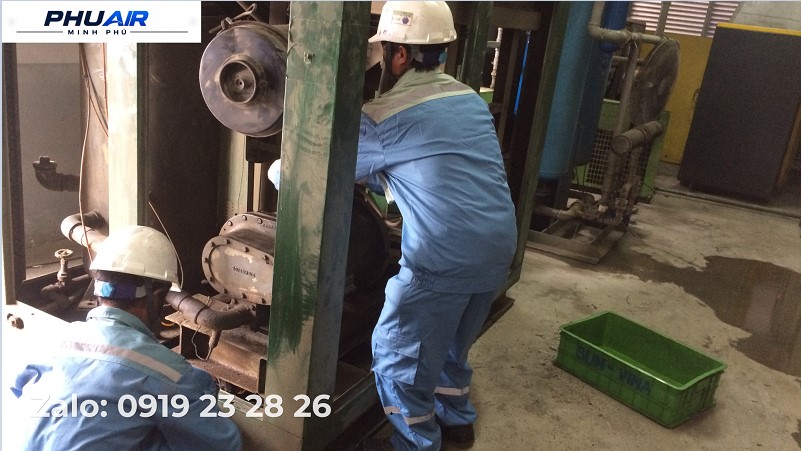
This is the most important factor. If the cause is only an operating setting, component replacement may not be necessary. Conversely, if a failed electrical component is identified, the repair cost will include both the component cost and the repair labor.
2.2. Machine Manufacturer and Model
Each air compressor manufacturer has different control configurations and spare parts, for example: Hitachi, Kobelco, Fusheng, Atlas Copco, Ingersoll Rand, CompAir, Hanbell, Kaishan... Even when two machines have the same power rating, the components used may still differ. Therefore, PhuAir needs to know the manufacturer + model + power rating + serial number before accurately identifying the required spare parts.
2.3. Machine Power Rating
Power rating also affects repair costs (for example, 7.5 kW, 15 kW, 22 kW, 37 kW, 75 kW, 110 kW...). Motors, inverters, contactors, and other electrical devices used on machines with different power ratings will have different specifications and costs.
2.4. Does the Machine Need Repair or Spare Parts Replacement?
Not every component with a problem needs to be replaced. Depending on the actual condition, the technician will proceed through: Inspection ➔ Repair ➔ Component Replacement ➔ Test Run. For example, with a contactor, it is necessary to specifically determine whether the issue is with the coil, contacts, control circuit, or power supply, rather than assuming "Contactor does not close = replace the contactor with a new one."
3. Reference Table for Repairing an Air Compressor That Will Not Run
Item | Common Condition | Estimated Cost Level |
|---|---|---|
Inspection and Diagnosis | Determine the cause of the machine not running on site. | Depends on actual on-site conditions |
Operating Fault Correction | Incorrect Auto/Manual mode, stuck Emergency Stop button, or incorrect settings. | May not require spare parts replacement |
Relay / Protection Device | Protection relay has tripped or a component has failed. | Depends on the device type |
Contactor (Magnetic Contactor) | Burned or worn contact surfaces, or failed pickup coil. | Depends on model & power rating |
Pressure / Temperature Sensor | Incorrect measurement signal or hardware failure. | Depends on sensor type |
Inverter | Fault indication; circuit board repair or replacement may be required. | Depends on power rating & model |
Motor | Insulation resistance fault or mechanical seizure. | Depends on repair/rewinding condition |
Controller (Micom/PLC) | Hardware, software, or signal fault. | Depends on machine manufacturer & model |
Note: The actual cost can only be determined after the root cause and machine configuration have been clearly identified.
4. When Can an Air Compressor Repair Be Completed at a Lower Cost?
A machine that will not run does not necessarily require component replacement. Some cases can be resolved relatively simply:
- The machine is in Manual mode: Simply return the machine to the appropriate automatic operating mode (Auto) according to its configuration.
- Emergency Stop is activated: Release the emergency stop button if there is no other short-circuit or fire-related fault.
- The Start threshold has not been reached: For example, if Start: 6.5 bar is configured and the current pressure is 7.0 bar, it is completely normal for the machine not to start.
- The machine is in Standby: In a multi-machine system, the machine may be set to standby and may not yet be scheduled to take the load.
5. When Can Repair Costs Be Higher?
Costs generally increase when the failure involves high-value components or requires more time for specialized technical work:
- Inverter failure: It is necessary to determine whether the fault can be reset, whether the circuit board needs to be repaired, or whether the entire inverter must be replaced.
- Motor failure: If the motor is actually damaged, the cost depends on whether it requires repair, winding rewinding, bearing replacement, or complete motor replacement.
- Controller failure: Hardware failure or main control board failure can result in costs that vary significantly depending on the manufacturer and machine generation.
6. Why Should You Not Quote a Repair Price Based Only on Machine Power?
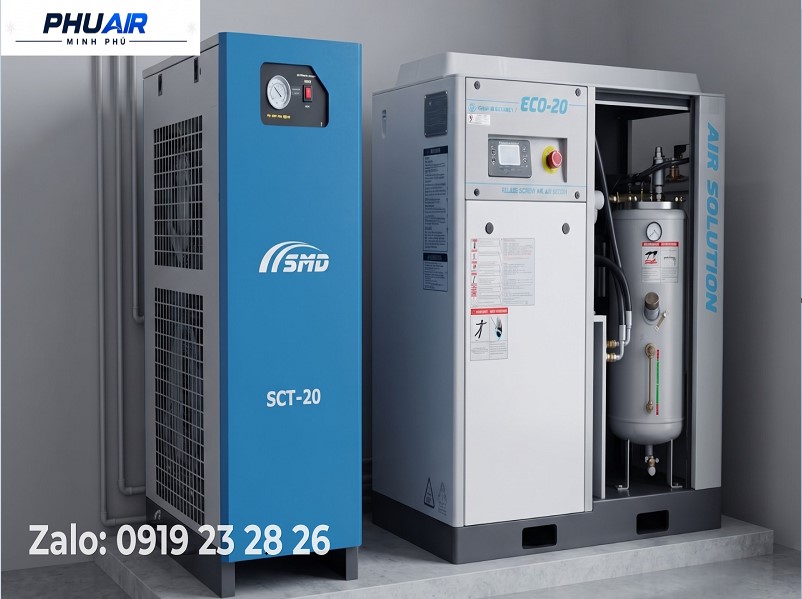
This is a common mistake when asking for a repair price, for example: "My Hitachi 22 kW compressor is not running. How much will the repair cost?" This information is not sufficient because even Hitachi 22 kW machines can differ in model, production year, control system, inverter, contactor, or spare parts configuration. Therefore, power rating is only one part of the information and cannot be used alone to determine the repair cost.
7. What Information Is Needed for an Accurate Air Compressor Repair Quotation?
PhuAir recommends that customers prepare at least the following information when making an inquiry:
Machine information: Manufacturer, Model, Power Rating (kW/HP), Serial Number.
Fault information: Symptom (Power is available but the machine does not run when START is pressed), Current Pressure, Operating Mode (Auto/Manual), and the fault code displayed on the screen (Alarm).
Actual Photos / Video: Photo of the machine nameplate, photo of the control display, fault code, and a video of the machine when the START button is pressed (if available).
8. PhuAir Process for Handling an Air Compressor That Will Not Run
To minimize incorrect quotations or unnecessary spare parts replacement, PhuAir applies the following standard process:
Step 1 - Receive Information: Collect the manufacturer, model, power rating, serial number, fault symptoms, and alarm code.
Step 2 - Preliminary Diagnosis: Check the power supply, circuit breaker, emergency stop button, operating mode, and system pressure.
Step 3 - Identify the Root Cause in Depth: Inspect the control circuit, relays, contactor, inverter, sensors, and motor.
Step 4 - Propose a Solution: Provide an on-site solution, component repair, spare parts replacement, or a combination with scheduled preventive maintenance.
Step 5 - Transparent Quotation: Provide a quotation based on the actual work items required, helping the customer optimize Total Cost of Ownership (TCO).
9. When Should You Repair and When Should You Replace?
Technicians should consider the equipment age, extent of damage, spare parts cost, lead time, and downtime cost. For low-value electrical components, replacement is generally appropriate. Conversely, for high-value equipment, the possibility of restoration should be clearly assessed before deciding to replace it.
👉 Don't just ask, "How much will the repair cost?" Instead, ask: "What is causing the machine not to run, and which corrective solution is the most cost-effective for the business?"
10. PhuAir Supports Air Compressor Repair When the Machine Will Not Run
PhuAir supports customers in inspecting and resolving the following conditions:
Air compressor will not start, has power but does not run.
Machine does not run when pressure drops or does not restart automatically after a power outage.
Contactor does not close, protection relay trips, or inverter displays a fault.
Machine starts and then stops suddenly, or has a sensor or control system fault.
👉 Need a quick quotation? Send the following information to PhuAir via Zalo:
Machine manufacturer + Model + Power Rating + Serial Number.
Specific fault symptoms + Fault code displayed on the screen (if any).
Photo of the machine nameplate and a video showing the fault.
The PhuAir technical team will help identify the root cause, provide an accurate corrective solution, and offer the most cost-effective quotation as quickly as possible.